
Honda Beat PP1
Import a Honda Beat (PP1) from Japan, found at auction, scanned before it ships, and delivered with a report anyone can verify.
- Built in Japan
- 1991–1996
- Engine
- E07A 656 cc mid-engine three, rear-wheel drive
About the PP1
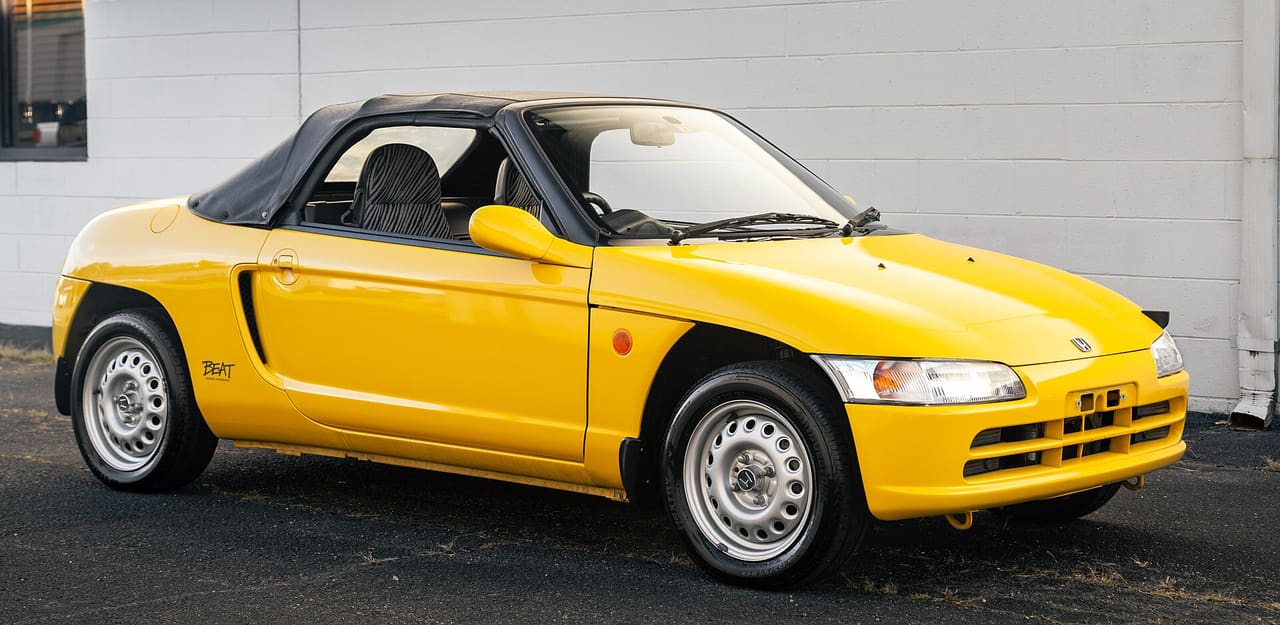
The Beat is a Japan-only kei roadster with a mid-mounted 656 cc three-cylinder engine driving the rear wheels. It revs high, costs little to run, and many parts are still available.
Production dates and output figures were not verified in our research, so we confirm each car’s build date from its export certificate before quoting. Provincial rules on kei cars vary, so check registration in your province before you buy.
Honda announced the Beat on 15 May 1991. Japanese Wikipedia calls it the world’s first mass-produced mid-engine car with a fully open monocoque body, and the first kei car with four-wheel disc brakes. Soichiro Honda attended its launch; it was the last new Honda car he saw before he died that August. Two 1992 special editions followed, the Version F (800 cars) and Version C (500 cars). Total production was 33,892.
- Power
- 64 PS at 8,100 rpm
- Torque
- 60 Nm at 7,000 rpm
- Weight
- 760 kg
- Gearbox
- 5-speed manual
- Drive
- Mid-engine, rear-wheel drive
- Engine
- E07A 656 cc three-cylinder, MTREC
- Built
- 33,892
Can a PP1 come in?
Both countries count from the month on the build plate, so a car can become eligible part-way through a year. We check the plate on every car.
Quebec registers right-hand-drive cars only at 25 years. Every other province follows the federal 15-year rule.
US sourcing is planned for 2027, once a customs broker confirms the duty rate on Japanese classics. Enquiries are welcome now.
Which cars roll in next? See the 2027 US calendar and the 2027 Canada calendar.
What to look at on a PP1
The model-specific weak points we look for in the auction sheet, the photos and the scan.
Rust
Worth checking the sills, rear subframe and engine bay.
Roof
Worth checking the soft top and rear screen for leaks.
Engine
Worth asking for the timing-belt history and checking for head-gasket trouble.
Cooling
Worth checking for overheating; the coolant runs from the front to the mid-mounted engine.
Gearbox
Worth checking the synchros on the five-speed.
What we check on every PP1
The auction sheet, in full
Every line of the original Japanese sheet translated: repair marks, rust notes, interior score.
The build plate
The month of manufacture decides eligibility, so we read it off the car, not the registration.
Mileage against the records
Dash and ECU against the auction sheet and Japan's inspection history.
Flood and accident history
Checked before export, while a claim is still possible.
A full diagnostic scan
Every module read inside the auction's 5-day claim window, so a hidden fault goes back to the seller.
Underneath
Chassis rails, floors and suspension, where snow-country salt does its damage.
What landing one costs: see the worked examples; an enquiry gets you the figure for this car. New to auction sheets? Read how to read one.
What a PP1 costs
Published figures with their source and date. Prices move with condition, mileage and grade; an enquiry gets auction results for the car you want.
| What | Price | Source |
|---|---|---|
| Japan used-car average asking price, May 1991–Dec 1996 generation Carsensor, Oct 2026 | about ¥1.24 million | Carsensor , Oct 2026 |
| Beat export and US listings, median asking price (304 listings) JDMBUYSELL, Oct 2026 | about US$7,200 | JDMBUYSELL , Oct 2026 |
| Median sold price, 13 seller-reported sales Feb 2024–Oct 2026 (not verified) JDMBUYSELL, Oct 2026 | about US$10,800 | JDMBUYSELL , Oct 2026 |
Figures as published by each source; not offers from us. Landed cost in Canada adds shipping, duty, GST/HST and provincial fees.
PP1 buyer questions
Is the Beat eligible to import?
Yes. Production ended in October 1995 and sales in December 1996, so every Beat is past both the Canadian 15-year rule and the US 25-year rule. Some provinces and states restrict kei cars, so check local registration first.
How fast is it?
Not very. The 656 cc three-cylinder makes 64 PS at 8,100 rpm, the kei-car limit, and revs to 8,500 rpm. It weighs 760 kg and has no power steering. It is built for fun at legal speeds, not highway pace.
What does a Beat cost?
Carsensor puts the Japanese average asking price at about ¥1.24 million in October 2026. On JDMBUYSELL the median asking price is about US$7,200 and the median seller-reported sale about US$10,800, before shipping and import costs.
Want a PP1?
Tell us the grade, colour and budget. We reply with eligibility for your province or state and what these are fetching in Japan now, and contact you when sourcing opens.