
Honda NSX NA1 / NA2
Import a Honda NSX (NA1 / NA2) from Japan, found at auction, scanned before it ships, and delivered with a report anyone can verify.
- Built in Japan
- 1990–2005
- Engine
- C30A 3.0 L V6 (C32B 3.2 L from 1997), mid-engine rear-wheel drive
About the NA1 / NA2
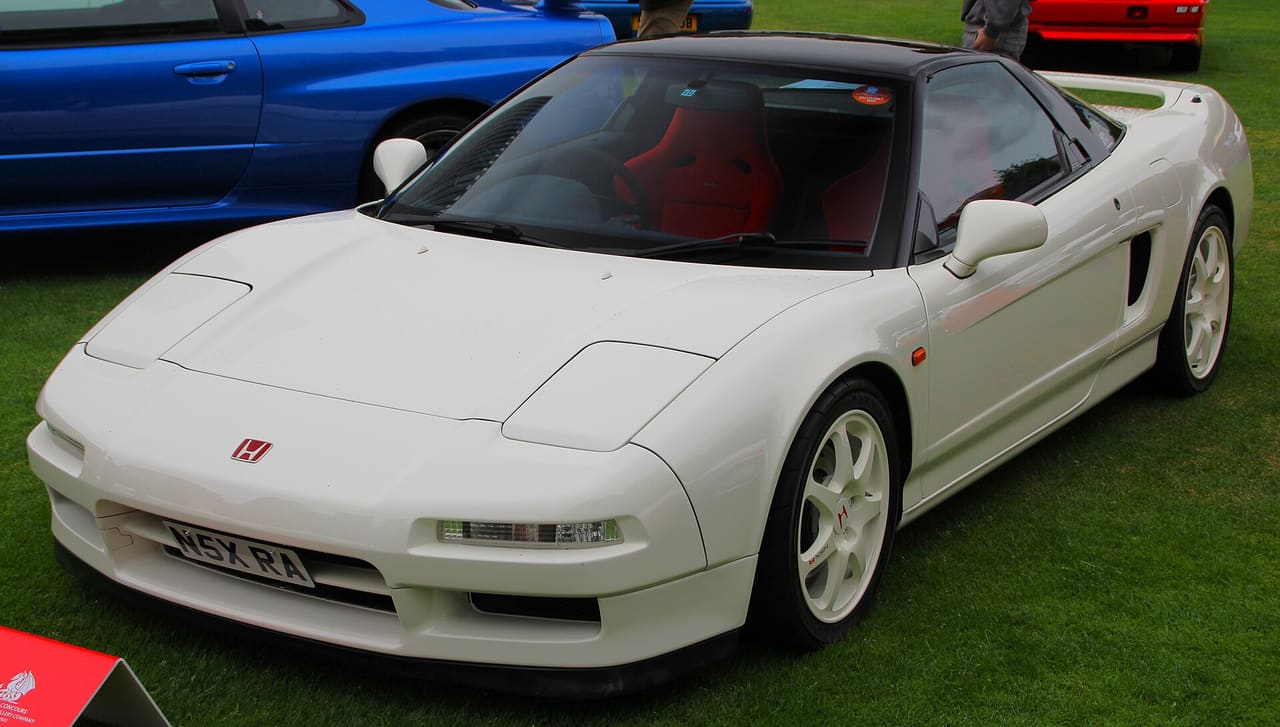
Honda announced the NSX in Japan on 13 September 1990 and it went on sale the next day (ja.wikipedia; Honda newsroom, Jul 2005). The C30A V6 made 280 PS with the manual and 265 PS with the four-speed automatic (ja.wikipedia).
From February 1997 manual cars moved to the 3.2 L C32B and a six-speed gearbox, chassis code NA2; automatics kept the 3.0 L (ja.wikipedia; Honda newsroom). Fixed headlights replaced the pop-ups in December 2001 (ja.wikipedia). Carsensor lists the Japan production run as September 1990 to December 2005, and Japanese Wikipedia dates the end of production to 26 December 2005. Honda reported more than 18,000 sold worldwide (Honda newsroom, Jul 2005).
The NSX was the first production car with an all-aluminium monocoque, built at Honda’s Takanezawa plant. Japanese Wikipedia says Ayrton Senna tested a prototype and criticised its rigidity, which led to more work at the Nürburgring. In 1995 Team Kunimitsu won the GT2 class at Le Mans with Kunimitsu Takahashi, Keiichi Tsuchiya and Akira Iida. In Japanese GT racing the NSX won GT500 titles in 2000 and 2007 and the GT300 title in 2004.
- Power
- 280 PS at 7,300 rpm (manual)
- Torque
- 294 Nm at 5,400 rpm (3.0 L)
- Torque (3.2 L NA2)
- 304 Nm at 5,300 rpm
- Weight
- 1,350 kg (manual)
- Gearbox
- 5-speed manual; 6-speed on NA2
- Drive
- Mid-engine, rear-wheel drive
- Sold
- 18,734 worldwide; 7,415 in Japan
Can an NA1 / NA2 come in?
Both countries count from the month on the build plate, so a car can become eligible part-way through a year. We check the plate on every car.
Quebec registers right-hand-drive cars only at 25 years. Every other province follows the federal 15-year rule.
US sourcing is planned for 2027, once a customs broker confirms the duty rate on Japanese classics. Enquiries are welcome now.
Which cars roll in next? See the 2027 US calendar and the 2027 Canada calendar.
What to look at on an NA1 / NA2
The model-specific weak points we look for in the auction sheet, the photos and the scan.
Early five-speed gearbox
On 1991–92 cars, check the gearbox number against the J4A4 range linked to snap-ring failures. Ask for proof of repair.
Aluminium body repairs
A magnet will not find filler on aluminium panels. Check panel fit and repair records, and use a body inspector who knows the NSX.
Window regulators
Test both windows. Check the switches and regulators before blaming the motor for slow glass.
Climate control
Test the display, every fan speed and cooling at idle. Leaking capacitors in the control unit are a known issue.
Type R authenticity
A genuine 1992–95 Type R has a five-speed, 4.235 final drive, and Recaro, MOMO and Enkei parts. Ask for Honda records.
Oil leaks and mounts
After a road test, look for oil at the valve covers and rear camshaft plugs. Knocking can mean torn engine mounts.
What we check on every NA1 / NA2
The auction sheet, in full
Every line of the original Japanese sheet translated: repair marks, rust notes, interior score.
The build plate
The month of manufacture decides eligibility, so we read it off the car, not the registration.
Mileage against the records
Dash and ECU against the auction sheet and Japan's inspection history.
Flood and accident history
Checked before export, while a claim is still possible.
A full diagnostic scan
Every module read inside the auction's 5-day claim window, so a hidden fault goes back to the seller.
Underneath
Chassis rails, floors and suspension, where snow-country salt does its damage.
What landing one costs: see the worked examples; an enquiry gets you the figure for this car. New to auction sheets? Read how to read one.
What an NA1 / NA2 costs
Published figures with their source and date. Prices move with condition, mileage and grade; an enquiry gets auction results for the car you want.
| What | Price | Source |
|---|---|---|
| Japan used-car average asking price, whole 1990–2005 generation Carsensor, Oct 2026 | about ¥15.25 million | Carsensor , Oct 2026 |
| NA1 export listings, median asking price (127 listings, mostly Japanese exporters) JDMBUYSELL, Oct 2026 | about US$83,500 | JDMBUYSELL , Oct 2026 |
| 2003 NSX-R (NA2), 15,806 km, Broad Arrow Villa d'Este auction Japanese Nostalgic Car, May 2025 | €934,375, about US$1.05 million with fees | Japanese Nostalgic Car , May 2025 |
Figures as published by each source; not offers from us. Landed cost in Canada adds shipping, duty, GST/HST and provincial fees.
NA1 / NA2 buyer questions
Can I bring an NSX into the US?
Cars built up to October 2001 pass the 25-year rule now. Fixed-headlight cars from December 2001 qualify from December 2026, and the NA2 NSX-R from May 2027. Canada accepts every NSX built from 1990 to 2005.
NA1 or NA2?
The NA1 uses the 3.0 L C30A with a five-speed manual. From February 1997 manual cars use the 3.2 L C32B and a six-speed, coded NA2, with more torque (304 Nm against 294 Nm). Automatics kept the 3.0 L at 265 PS.
How rare is the 1992 Type R?
Japanese Wikipedia says 480 were registered, and Honda removed about 120 kg. Verify one with Honda records and the correct five-speed, Recaro, MOMO and Enkei parts, because replicas built from ordinary cars exist.
Want an NA1 / NA2?
Tell us the grade, colour and budget. We reply with eligibility for your province or state and what these are fetching in Japan now, and contact you when sourcing opens.