
Honda S2000 AP1 / AP2
Import a Honda S2000 (AP1 / AP2) from Japan, found at auction, scanned before it ships, and delivered with a report anyone can verify.
- Built in Japan
- 1999–2009
- Engine
- F20C 2.0 L naturally aspirated four (F22C 2.2 L from 2005), rear-wheel drive
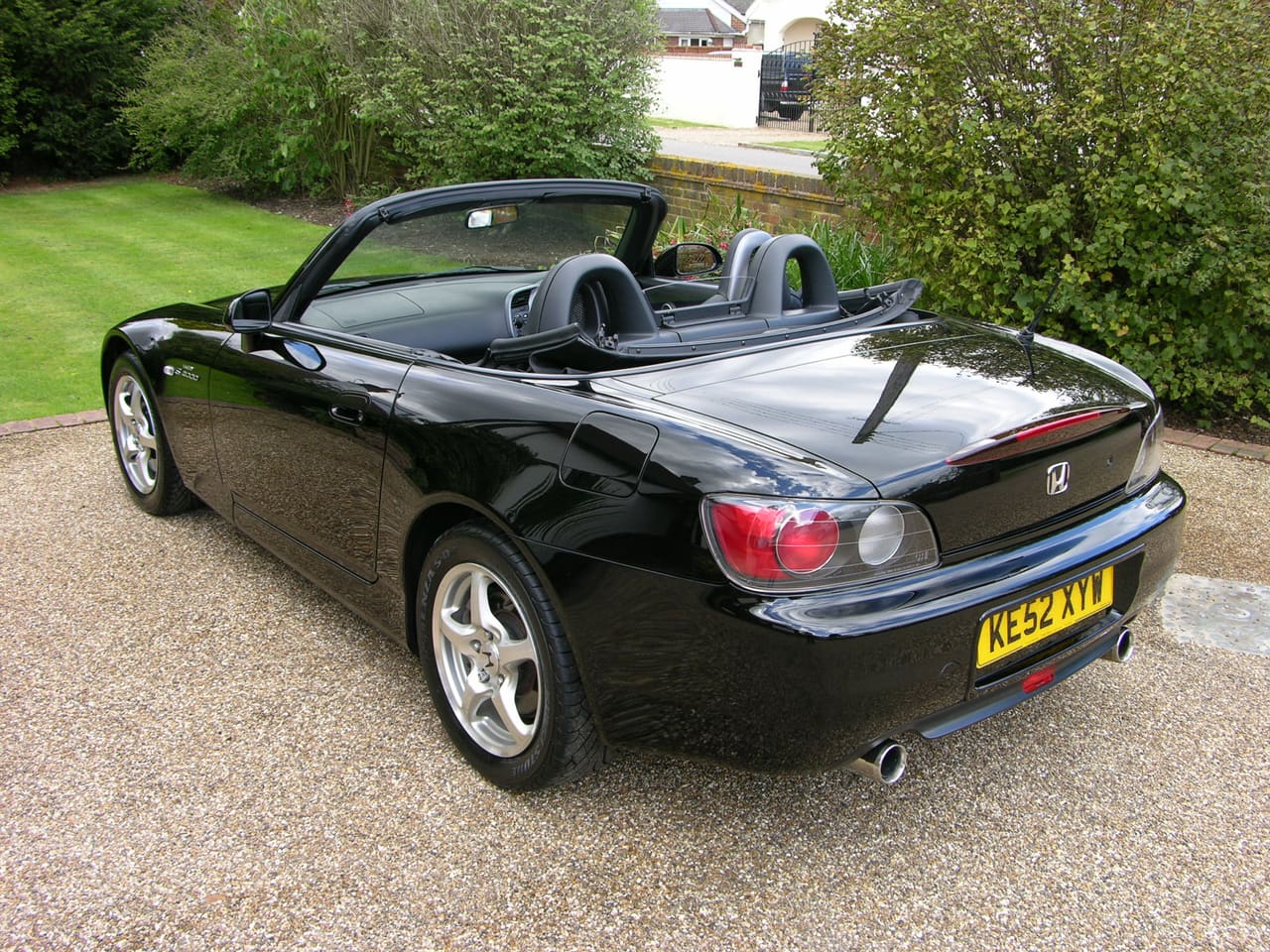
About the AP1 / AP2
The S2000 went on sale in Japan on 15 April 1999 with the 2.0 L F20C, rated at 250 PS at 8,300 rpm (ja.wikipedia; Honda newsroom, Jan 2009). The Type V arrived in July 2000 with variable-ratio steering (VGS), which Honda says was a world first (Honda newsroom).
In November 2005 the engine grew to the 2.2 L F22C (242 PS) and the chassis code changed to AP2 (ja.wikipedia). The Type S followed in October 2007 (Honda newsroom). Honda planned to end production in June 2009 (Honda newsroom, Jan 2009). Japanese Wikipedia says demand kept the line running into early August 2009, and sales ended in September 2009 once stock sold out. Honda reported more than 20,000 sold in Japan.
Honda announced the S2000 in 1998 to mark its 50th anniversary. It was the company’s first front-engine, rear-drive car since the S800 28 years earlier, and grew from the SSM concept shown at the 1995 Tokyo Motor Show. NSX engineers, including Shigeru Uehara, developed it around a high X-bone frame. The F20C made 125 PS per litre. Production began at Takanezawa and moved to Suzuka in 2004.
- Power (AP1)
- 250 PS at 8,300 rpm
- Torque (AP1)
- 218 Nm at 7,500 rpm
- Power (AP2)
- 242 PS at 7,800 rpm
- Weight
- 1,240–1,260 kg (AP1)
- Gearbox
- 6-speed manual
- Drive
- Rear-wheel drive
- Sold
- 21,662 registered new in Japan
Can an AP1 / AP2 come in?
Both countries count from the month on the build plate, so a car can become eligible part-way through a year. We check the plate on every car.
Quebec registers right-hand-drive cars only at 25 years. Every other province follows the federal 15-year rule.
US sourcing is planned for 2027, once a customs broker confirms the duty rate on Japanese classics. Enquiries are welcome now.
Which cars roll in next? See the 2027 US calendar and the 2027 Canada calendar.
What to look at on an AP1 / AP2
The model-specific weak points we look for in the auction sheet, the photos and the scan.
Valve retainers
On AP1 cars, ask about missed shifts. A mechanic can pull the valve cover and look for recessed keepers, which signal cracked retainers.
Oil use
The F20C uses oil; up to a litre per 1,000 miles is normal. Neglect can wear the bearings.
Soft top and rear screen
The vinyl roof cracks and shrinks. Early cars have plastic rear screens that fog or split. Lift the carpets to check for damp.
Rear arches and subframe
Check behind the rear arch liners for rust, and the subframe around the rear trailing-arm mounts.
Gearbox
Some 2004–2009 cars pop out of 2nd, 4th or 6th gear. Shift through every gear, including reverse.
Type V check
A genuine Type V has VGS steering (1.4 turns lock to lock), its own steering wheel and a rear VGS badge.
What we check on every AP1 / AP2
The auction sheet, in full
Every line of the original Japanese sheet translated: repair marks, rust notes, interior score.
The build plate
The month of manufacture decides eligibility, so we read it off the car, not the registration.
Mileage against the records
Dash and ECU against the auction sheet and Japan's inspection history.
Flood and accident history
Checked before export, while a claim is still possible.
A full diagnostic scan
Every module read inside the auction's 5-day claim window, so a hidden fault goes back to the seller.
Underneath
Chassis rails, floors and suspension, where snow-country salt does its damage.
What landing one costs: see the worked examples; an enquiry gets you the figure for this car. New to auction sheets? Read how to read one.
What an AP1 / AP2 costs
Published figures with their source and date. Prices move with condition, mileage and grade; an enquiry gets auction results for the car you want.
| What | Price | Source |
|---|---|---|
| Japan used-car average asking price, all S2000s Carsensor, Oct 2026 | about ¥4.69 million | Carsensor , Oct 2026 |
| Export and US listings, median asking price (172 listings) JDMBUYSELL, Oct 2026 | about US$21,600 | JDMBUYSELL , Oct 2026 |
| Median sold price, 11 seller-reported sales Jan 2025–Sep 2026 (not verified) JDMBUYSELL, Oct 2026 | about US$24,950 | JDMBUYSELL , Oct 2026 |
Figures as published by each source; not offers from us. Landed cost in Canada adds shipping, duty, GST/HST and provincial fees.
AP1 / AP2 buyer questions
Which S2000s can go to the US now?
Only AP1 cars built up to October 2001 pass the 25-year rule. Later AP1s qualify month by month from November 2026, and the 2.2 L AP2 from November 2030. Canada accepts every S2000 built from 1999 to 2009.
What is the Type V?
A Japan-only grade from July 2000 with variable gear ratio steering (VGS) and softer suspension. It was dropped in 2008. Check for the VGS badge and its own steering wheel, and test-drive it, because the quick steering is not to every taste.
Should I worry about the F20C?
It makes 250 PS at 8,300 rpm and revs very high. Ask about missed shifts, which can crack valve retainers, and expect some oil use. The 2.2 L F22C in the AP2 has more mid-range torque but 242 PS.
Want an AP1 / AP2?
Tell us the grade, colour and budget. We reply with eligibility for your province or state and what these are fetching in Japan now, and contact you when sourcing opens.