
Mitsubishi Lancer Evolution II / III CE9A
Import a Mitsubishi Lancer Evolution II / III (CE9A) from Japan, found at auction, scanned before it ships, and delivered with a report anyone can verify.
- Built in Japan
- 1994–1996
- Engine
- 4G63 2.0 L turbo four, all-wheel drive
About the CE9A
The Evo II ran from January 1994 to February 1995, and the Evo III from February 1995 to August 1996. Both use the 4G63 turbo four with all-wheel drive: the Evo II makes 260 PS and the Evo III 270 PS, each with 309 Nm. The Evo II gained a mechanical plate-type rear limited-slip differential.
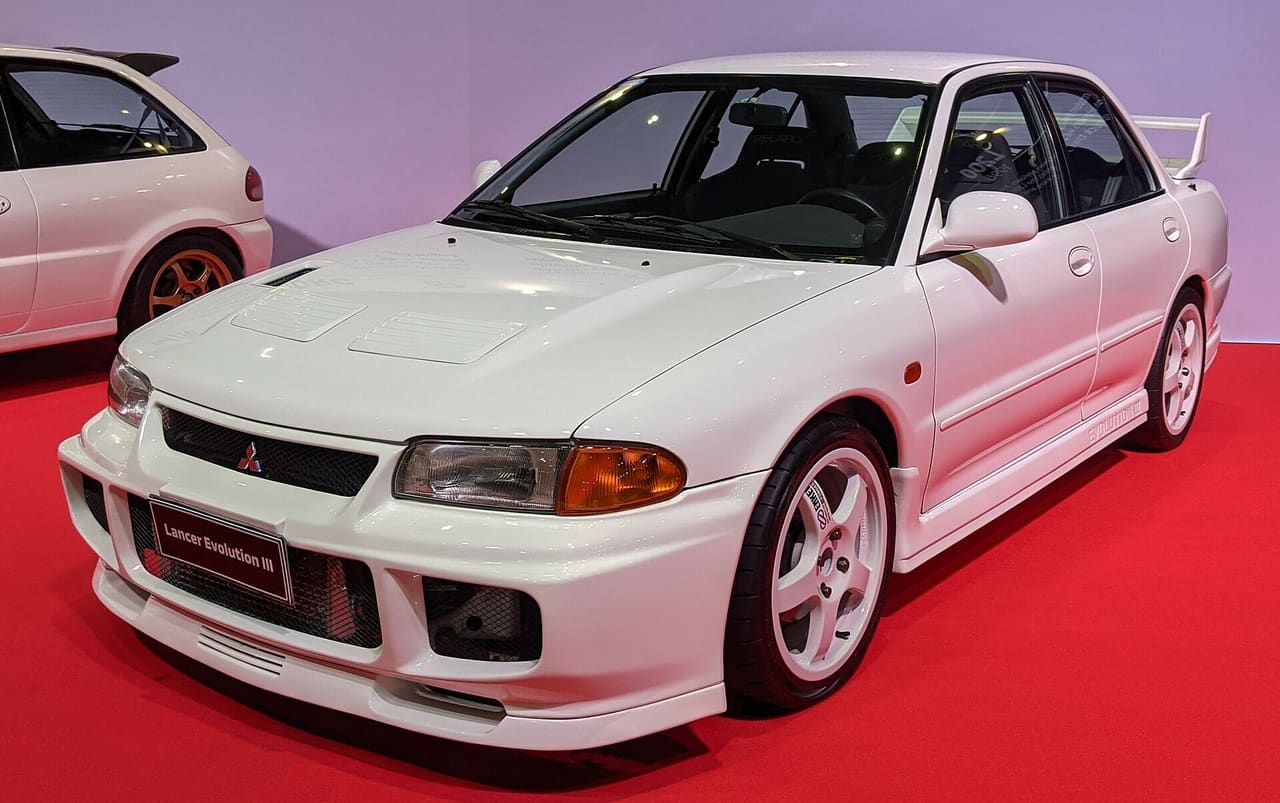
The Evo III is the Mäkinen-era Group A car with the big aero bumper, and both are light and analogue to drive.
The Evo II gave the Lancer Evolution its first WRC win, at the 1995 Swedish Rally. The Evo III then carried Tommi Mäkinen to the 1996 drivers’ title, the first of his four in a row, and Gustavo Trelles won the Group N title in an Evo III. In Japan the Evo III now asks well above the Evo II: Carsensor averages are about ¥4.2 million against ¥2.8 million.
- Power
- II: 260 PS; III: 270 PS at 6,250 rpm
- Torque
- 31.5 kgm at 3,000 rpm
- Weight
- II GSR 1,250 kg; III GSR 1,260 kg
- Gearbox
- 5-speed manual
- Drive
- Full-time all-wheel drive
- Sold
- Evo III GSR: 8,998
Can a CE9A come in?
Both countries count from the month on the build plate, so a car can become eligible part-way through a year. We check the plate on every car.
Quebec registers right-hand-drive cars only at 25 years. Every other province follows the federal 15-year rule.
US sourcing is planned for 2027, once a customs broker confirms the duty rate on Japanese classics. Enquiries are welcome now.
Which cars roll in next? See the 2027 US calendar and the 2027 Canada calendar.
What to look at on a CE9A
The model-specific weak points we look for in the auction sheet, the photos and the scan.
Generation
Confirm the generation: “Evolution II” is embossed under the rear spoiler; the Evo III has its own bumper and build date.
Anti-lag
Evo III anti-lag hardware reportedly shipped disabled in the ECU. Ask whether it has been activated.
Rear LSD
Check the rear limited-slip differential for noise and wear.
Rust
Worth checking the rear chassis legs, fuel filler area and arches.
What we check on every CE9A
The auction sheet, in full
Every line of the original Japanese sheet translated: repair marks, rust notes, interior score.
The build plate
The month of manufacture decides eligibility, so we read it off the car, not the registration.
Mileage against the records
Dash and ECU against the auction sheet and Japan's inspection history.
Flood and accident history
Checked before export, while a claim is still possible.
A full diagnostic scan
Every module read inside the auction's 5-day claim window, so a hidden fault goes back to the seller.
Underneath
Chassis rails, floors and suspension, where snow-country salt does its damage.
What landing one costs: see the worked examples; an enquiry gets you the figure for this car. New to auction sheets? Read how to read one.
What a CE9A costs
Published figures with their source and date. Prices move with condition, mileage and grade; an enquiry gets auction results for the car you want.
| What | Price | Source |
|---|---|---|
| Evo II, built January 1994–January 1995, Carsensor average asking price Carsensor, Oct 2026 | about ¥2.80 million | Carsensor , Oct 2026 |
| Evo III, built February 1995–July 1996, Carsensor average asking price Carsensor, Oct 2026 | about ¥4.22 million | Carsensor , Oct 2026 |
Figures as published by each source; not offers from us. Landed cost in Canada adds shipping, duty, GST/HST and provincial fees.
CE9A buyer questions
Are the Evo II and III eligible?
Yes. Both were built between January 1994 and mid-1996, so every car is more than 25 years old and eligible in both the US and Canada.
Evo II or Evo III?
The Evo III has more power, 270 PS against 260 PS, the larger aero bumper and the Mäkinen title history, and it costs more. The Evo II is the cheaper way into an early, light Evo and gained a mechanical rear limited-slip differential.
What is the expensive weak point?
Rust in the rear chassis legs, fuel filler area and arches is the costliest problem on early Evos. Check the rear limited-slip differential for noise and ask for cambelt records on the 4G63.
Want a CE9A?
Tell us the grade, colour and budget. We reply with eligibility for your province or state and what these are fetching in Japan now, and contact you when sourcing opens.