
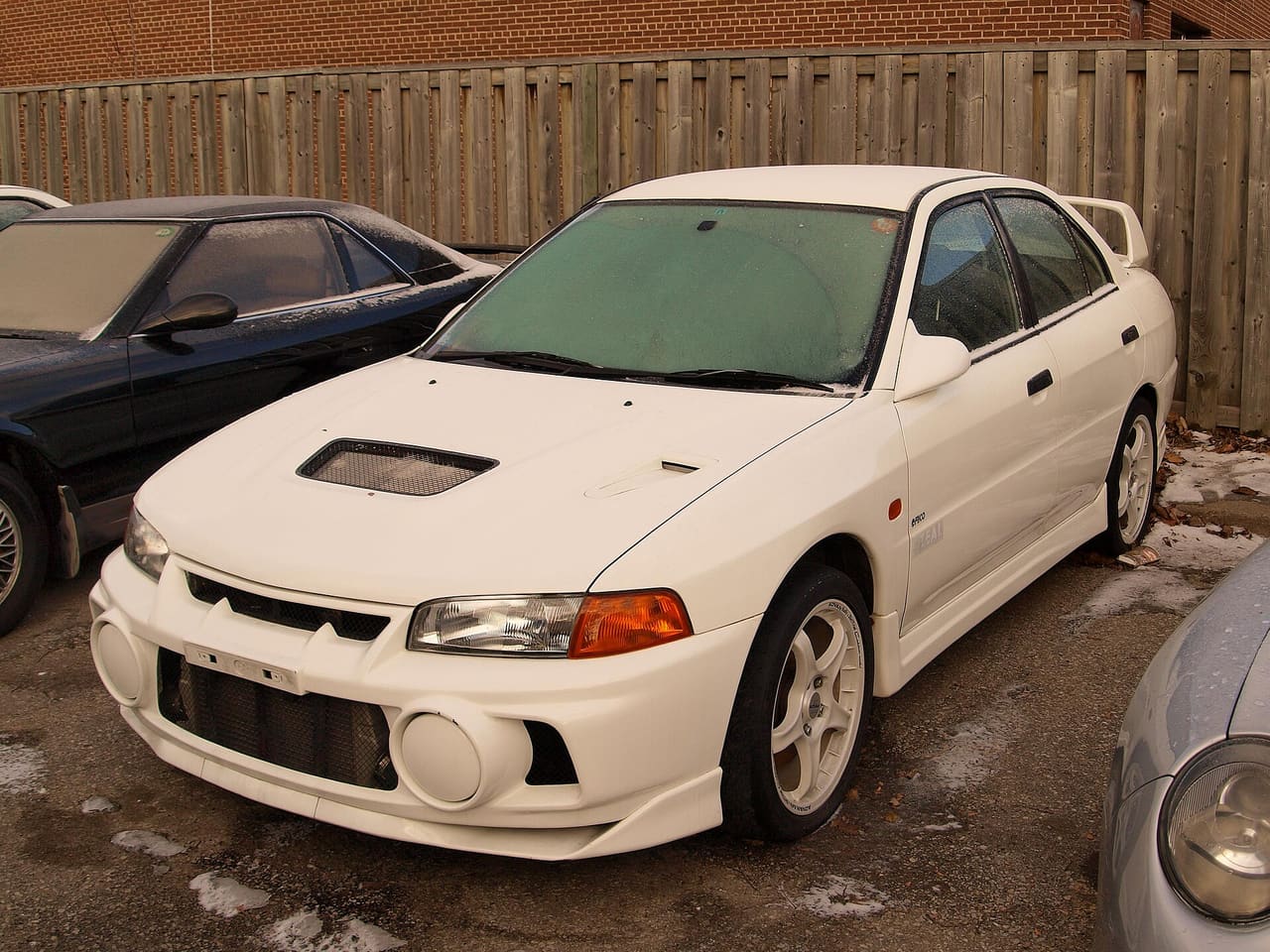
Mitsubishi Lancer Evolution IV CN9A
Import a Mitsubishi Lancer Evolution IV (CN9A) from Japan, found at auction, scanned before it ships, and delivered with a report anyone can verify.
- Built in Japan
- 1996–1998
- Engine
- 4G63 2.0 L turbo four, all-wheel drive
About the CN9A
The Evo IV was built from August 1996 to January 1998. It was the first ground-up redesign of the Evolution, on a new Lancer body, and it keeps the 4G63 2.0 L turbo four and all-wheel drive.
It sits between the early Group A cars and the widebody Evo V, which followed in January 1998. JDMBuySell lists no recent price data, so each car is valued on its own condition and history.
The Evo IV turned the engine around in the bay, removed an intermediate gear to cut drivetrain loss, and introduced a multi-link rear and AYC, which splits drive between the rear wheels. It also brought a twin-scroll turbo and forged pistons. Tommi Mäkinen won the 1997 WRC drivers’ title in it, with wins in Portugal, Catalunya, Argentina and Finland, and it won in Sweden and Kenya early in 1998.
- Power
- 280 PS at 6,500 rpm
- Torque
- 36.0 kgm at 3,000 rpm
- Weight
- 1,350 kg (GSR)
- Gearbox
- 5-speed manual
- Drive
- All-wheel drive (AYC on GSR)
- Sold
- GSR: 12,193
Can a CN9A come in?
Both countries count from the month on the build plate, so a car can become eligible part-way through a year. We check the plate on every car.
Quebec registers right-hand-drive cars only at 25 years. Every other province follows the federal 15-year rule.
US sourcing is planned for 2027, once a customs broker confirms the duty rate on Japanese classics. Enquiries are welcome now.
Which cars roll in next? See the 2027 US calendar and the 2027 Canada calendar.
What to look at on a CN9A
The model-specific weak points we look for in the auction sheet, the photos and the scan.
AYC
On cars with AYC, worth checking that the lamp goes out after start-up and listening for groaning on tight turns.
Gearbox
Worth listening for gearbox whine from the input-shaft bearings.
Rust
Worth checking the rear chassis legs, fuel filler neck and door bottoms.
Cambelt
Ask when the cambelt was last changed.
Modifications
Ask for the tuning history and any engine work.
What we check on every CN9A
The auction sheet, in full
Every line of the original Japanese sheet translated: repair marks, rust notes, interior score.
The build plate
The month of manufacture decides eligibility, so we read it off the car, not the registration.
Mileage against the records
Dash and ECU against the auction sheet and Japan's inspection history.
Flood and accident history
Checked before export, while a claim is still possible.
A full diagnostic scan
Every module read inside the auction's 5-day claim window, so a hidden fault goes back to the seller.
Underneath
Chassis rails, floors and suspension, where snow-country salt does its damage.
What landing one costs: see the worked examples; an enquiry gets you the figure for this car. New to auction sheets? Read how to read one.
What a CN9A costs
Published figures with their source and date. Prices move with condition, mileage and grade; an enquiry gets auction results for the car you want.
| What | Price | Source |
|---|---|---|
| Evo IV, built August 1996–December 1997, Carsensor average asking price Carsensor, Oct 2026 | about ¥3.02 million | Carsensor , Oct 2026 |
Figures as published by each source; not offers from us. Landed cost in Canada adds shipping, duty, GST/HST and provincial fees.
CN9A buyer questions
Is the Evo IV eligible?
Yes. It was built from August 1996 to January 1998, so every car is more than 25 years old and can be imported into both the US and Canada.
Why is it cheaper than the Evo V and VI?
It has the narrow body, not the widebody of the Evo V and VI. On Carsensor, Evo IV-period cars average about ¥3.0 million, against about ¥4.3 million for 1998 builds and ¥5.2 million for 1999 builds.
What about the early AYC?
Japanese Wikipedia notes that early AYC units could be noisy, and some owners swapped in aftermarket limited-slip differentials. Check the AYC lamp goes out after start-up and confirm which differential is fitted.
Want a CN9A?
Tell us the grade, colour and budget. We reply with eligibility for your province or state and what these are fetching in Japan now, and contact you when sourcing opens.